Capabilities
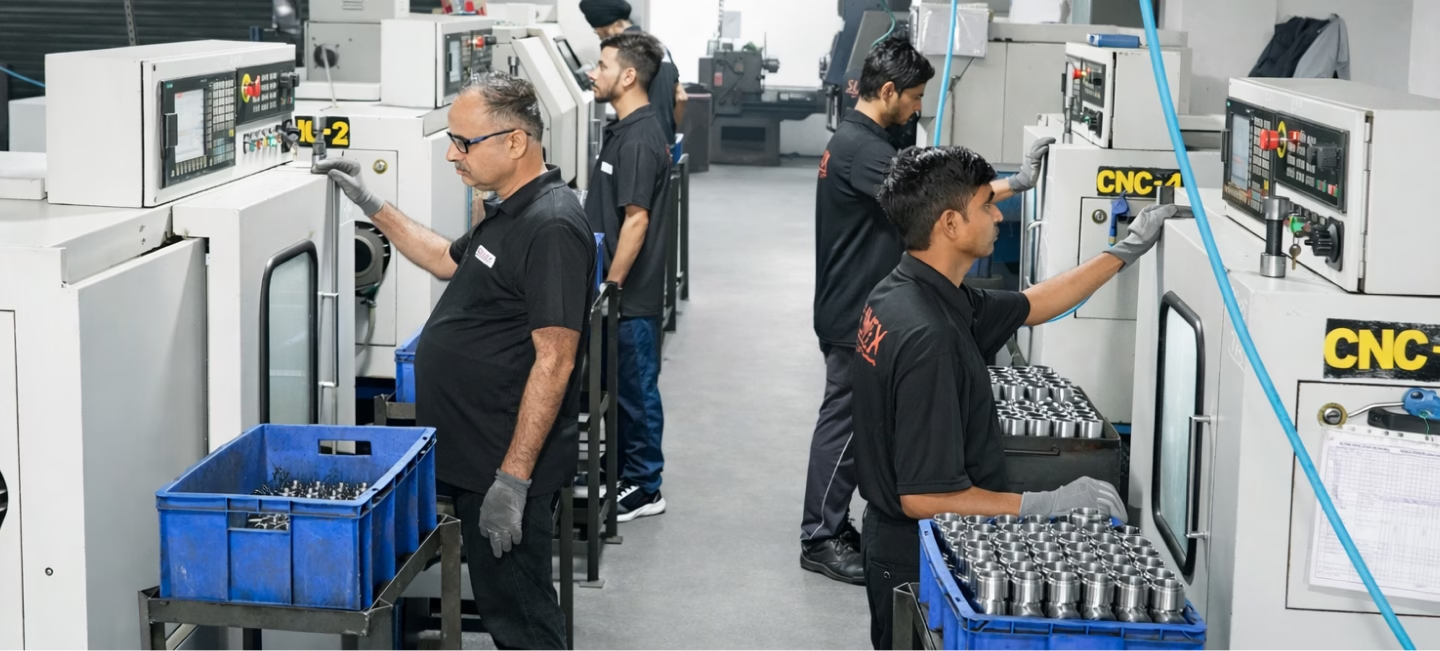
Sumex Auto Tech operates a process-integrated facility for driveline component manufacturing. The setup combines CNC/VMC/HMC machining, gear hobbing, broaching, induction hardening, centreless and cylindrical grinding, and surface finishing under one roof — enabling control over dimensional geometry, metallurgical properties, and batch consistency throughout production.
Critical features are maintained within tolerances up to ±0.005 mm, supported by in-process inspection at defined production stages and final verification before batch release. Statistically consistent output across production lots is a baseline requirement, not a claimed aspiration.
Manufacturing Capabilities
CNC / VMC / HMC Machining
- CNC turning of UJ crosses, shafts, and yoke bodies — Diameter control, shoulder geometry, and face features maintained to drawing
- VMC multi-face milling — Positional and angular feature accuracy across multiple faces in a single setup
- HMC batch production — Consistent datum referencing and throughput for production lots
- Multi-axis capability — Complex geometries machined in-house without outsourcing
Gear & Spline Processing
- Gear hobbing for external spline profiles — Controlled module, pressure angle, and profile accuracy for mating component fitment
- Broaching for internal splines — Consistent bore geometry and keyway/spline fitment across production lots
Heat Treatment — Induction Hardening & Surface Hardening
- Induction hardening on trunnion diameters, bearing seats, and spline roots — Controlled case depth and HRC hardness — verified batch-by-batch per ASTM E18
- Core hardness maintained throughout — Preserves fatigue toughness in the component body while hardening the functional surface
- Batch-wise consistency verified — No post-hardening dimensional instability accepted without root cause review
Note: Surface hardening parameters (case depth, hardness profile) aligned with application fatigue requirements. Induction hardening and controlled carburising methods applied as appropriate to material grade and component specification.
Grinding & Finishing
- Centreless grinding for trunnion ODs, shafts, and pins — Final size and surface finish (Ra) for bearing seat fitment
- Cylindrical grinding for bores and critical diameters — Roundness and diameter compliance on functional contact surfaces
Surface Treatment
- Shot blasting — Oxide and scale removal prior to inspection and coating
- Glide coating — Corrosion resistance and assembly-compatible surface condition on functional features
Engineering Capability
- Drawing interpretation and GD&T evaluation — ISO 1101, ISO 2768, ISO 286
- Reverse engineering and dimensional benchmarking from samples or worn components
- Process planning and routing for new component development
- FEM-informed design review on request for critical applications
- Batch control, repeatability verification, and Cpk assessment on request
Materials Processed
Material | Specification Reference | Typical Application |
|---|---|---|
Alloy steels | EN 10083, SAE / ASTM A29 — grade per application | UJ crosses, yokes, shafts |
Carbon steels | EN 10277 / EN 10278, relevant IS specifications | Flanges, hubs, fabrication parts |
Hubs, castings, off-highway components | Application-specific grade | Hubs, castings, off-highway components |
All material inputs are processed with traceable heat numbers, verified against controlled specifications, and linked to the production lot record.
Process Flow
Raw Material
CNC/VMC/HMC Machining
Gear Hobbing / Broaching
Induction Hardening / Surface Hardening
Centreless / Cylindrical Grinding
Shot Blasting / Coating
In-Process & Final Inspection
Batch Release & Dispatch
Raw Material
CNC/VMC/HMC Machining
Gear Hobbing / Broaching
Induction Hardening / Surface Hardening
Centreless / Cylindrical Grinding
Shot Blasting / Coating
In-Process & Final Inspection
Batch Release & Dispatch
Have a component drawing or development requirement?
Share your CAD file or dimensional specification. We will review manufacturability, tolerance feasibility, and process routing before submission.